
Blog
Last Updated: October 26, 2026
Choosing steel vs aluminum for custom architectural metal features depends on the job: steel carries more load and stiffness for structural frames, heavy gates, and slim long spans, while aluminum weighs about a third as much and resists rust without a coating, suiting railings, cladding, and decorative exterior work. Neither wins outright, so match the metal to what the feature must do.
Choosing between steel vs aluminum for custom architectural metal features shapes cost, maintenance, structural detailing, and longevity. At Antonio's Metal Works, we have fabricated both for over two decades, and neither wins outright, the right pick depends on what the feature has to do.
Steel delivers higher strength and stiffness for a given section, making it the default for structural frames, heavy gates, and anything carrying real load.
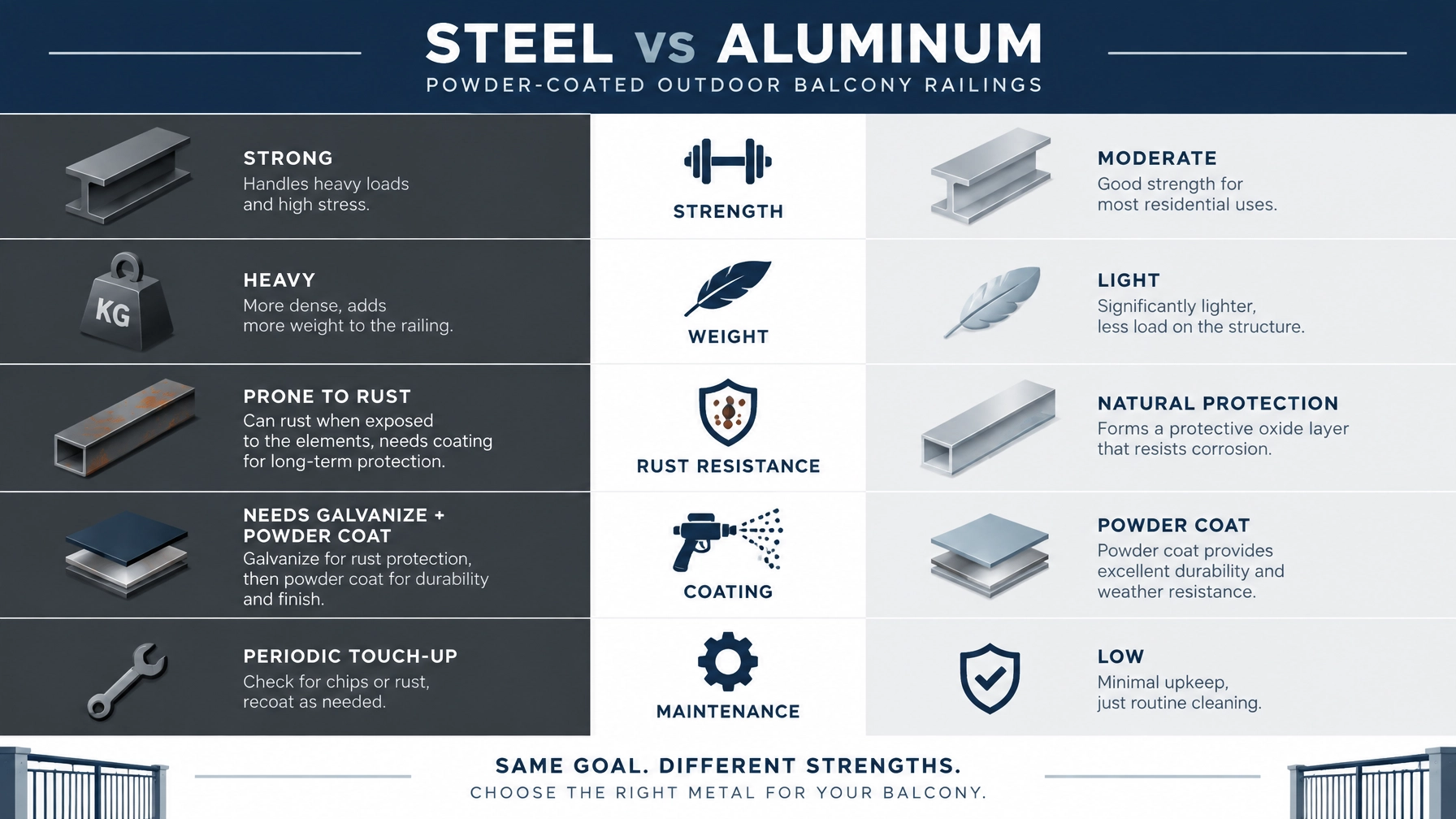
Steel wins on load-bearing capacity, and it is not close. A steel member of the same dimensions as an aluminum one will carry substantially more load and deflect less under it.
The reason is stiffness: steel holds its shape under stress far better than aluminum.
If your project involves structural steel design and detailing, see the structural steel design and detailing services we provide, including Tekla 3D modeling to catch fit issues before fabrication begins.
Aluminum has the better strength-to-weight ratio, and that is its real advantage.
In practice, an aluminum railing or canopy panel can be lifted by fewer people, stresses attachment points less, and reduces the load the building carries, changing the installation plan for rooftop and high-up features.
Steel's density buys design flexibility differently: it welds into tighter, stronger joints and holds fine detail well, so ornamental gates often come out cleaner in steel.
Aluminum resists corrosion far better than bare steel outdoors, driving most exterior material selection. It forms a thin oxide layer that protects it from moisture, so it holds up in coastal air and wet climates without constant attention.
Steel is not disqualified outdoors, it just needs protection. Galvanizing, powder coating, and quality paint systems extend its service life significantly, and a properly finished steel feature can last decades.
Rust is the number one failure mode for steel outdoors, and moisture is the trigger.
Aluminum still benefits from a finish, even though it does not rust. The Aluminum Association's design guidance covers how alloy choice and finish interact, which is worth reviewing before you specify an exterior aluminum feature.
Indoor applications flip the calculation. Without rain and salt air, bare or lightly finished steel performs fine, and its strength and cost advantages carry more weight.


For outdoor railings, aluminum is usually the better default, especially near the coast.
Steel earns its place outdoors when the design calls for slim profiles, long unsupported spans, or heavy ornamental detail. Steel railings use thinner members than aluminum to meet the same load requirements, giving a cleaner look.
A simple way to decide:
| Feature | Choose steel | Choose aluminum |
|---|---|---|
| Load-bearing frames and stair stringers | Yes | Rarely |
| Coastal or high-moisture railings | Only with strong coating | Yes |
| Slim profiles and long spans | Yes | Needs deeper sections |
| Lightweight rooftop or high installation | No | Yes |
| Ornamental detail and tight joints | Yes | Workable |
For exterior features where appearance and longevity matter, a properly finished aluminum railing is hard to beat. Where structure and detail dominate, steel is the safer call.
Steel is generally cheaper per pound. Aluminum costs more per pound, and because it is less stiff, an aluminum design often needs more material to hit the same performance, narrowing the gap. The cost of steel vs aluminum fabrication rarely comes down to the metal alone, what matters is total installed cost over the feature's service life.
Break a quote into its real cost buckets and the comparison changes by feature type:
The right question is which metal costs less to own. A few patterns hold across most projects:
Watch Out Comparing quotes on material price alone is the most common mistake we see. A low steel bid that skips a proper coating system will cost more in repairs than the savings ever covered. Ask every bidder to state the coating system, the surface preparation, and the maintenance interval they are assuming.
When you line up a steel quote against an aluminum quote, normalize them before you decide:
That normalization is where lifecycle value becomes a real number instead of a slogan.
Steel is easier to weld and machine than aluminum, which shapes how a project runs. Steel tolerates more welding methods, holds its shape during heating, and machines predictably.
Steel supports cutting, bending, and joining with fewer surprises. Aluminum is workable in experienced hands but rewards a shop that knows its quirks. For complex structural work, steel's forgiveness shortens the schedule; for decorative aluminum, fabricator skill matters more than the material.
If you are weighing joining methods, our guide on choosing the right welding method breaks down MIG, TIG, and stick for different metals and projects. For a deeper look at techniques across both materials, see how custom metal fabrication methods apply to tailored steel and aluminum solutions.
Galvanic corrosion trips up more projects than any other detail, and most comparisons skip it. When aluminum and steel touch in the presence of moisture, the aluminum becomes the anode and corrodes preferentially. The rate depends on the electrolyte, the surface area ratio, and how long moisture sits at the joint. Any design joining the two metals needs an insulating barrier, separator, or coating at the contact point, skip it, and the joint fails early, often at the fastener line.
A few detailing habits prevent most galvanic problems:
Structural detailing matters as much as corrosion protection. Steel and aluminum expand at different rates, so mixed-material assemblies need movement accounted for in the connections. Aluminum's lower stiffness means deflection limits must be checked carefully on long spans, and steel connections detailed so coatings stay intact after welding.
A few specifics that change the detailing:
Building-code and project specification considerations belong here too. Load requirements, fire ratings, and finish specifications all influence material choice, and the International Code Council's building codes set the framework most projects fall under. Confirm local amendments and engineer sign-off before fabrication starts.
A practical checklist for coordinating material selection with the project specification:
Key Takeaway Material choice is a detailing decision as much as a strength decision. The projects that fail are rarely the ones that picked the wrong metal; they are the ones that picked a metal and then detailed it as if it were the other one.
The right material choice is only as good as the shop that fabricates it. A design that looks correct on paper can fail on site if the fabricator misreads the specs or misses a galvanic corrosion detail.
At Antonio's Metal Works, we are a family-owned shop with over two decades of experience, a C-51 Structural Steel Contractor License, and a track record of interpreting complex architectural plans accurately. We handle precision design and detailing to avoid costly rework, and we deliver on schedule. Our past work includes projects like Bethel Housing, North Park Community Center, Golden Hill, and Quince Apartments.
Before you commit, read what our clients say about working with us. When you are ready, explore our custom metal design work and see what fits your space, then reach out for a quote.
Neither wins outright; the feature decides. Steel suits structural frames, heavy railings, and spans that carry large loads because of its high strength. Aluminum suits cladding, decorative panels, and lightweight structures where weight and corrosion resistance matter most. For outdoor railings, aluminum resists rust without heavy maintenance, while steel needs a protective coating. A fabricator who reads your drawings can match the material to the load, exposure, and finish you need.
Yes, but direct contact between them invites galvanic corrosion, especially outdoors where moisture bridges the joint. The fix is isolation: use stainless steel fasteners, neoprene or nylon washers, and isolating tape at the connection. A qualified fabricator details these breaks during design so the assembly holds up over its service life. Skipping isolation is one of the most common causes of premature failure in mixed-metal features.
Aluminum generally holds up better outdoors because it forms a natural oxide layer that protects the surface, and it does not rust the way steel does. Steel will corrode when moisture and oxygen reach bare metal, so it needs galvanizing, powder coating, or paint to survive exterior exposure. In coastal conditions with salt air, aluminum and properly coated steel both need attention, but aluminum usually needs less ongoing maintenance.
It depends on the project. Aluminum often costs more per pound as a raw material, but its lighter weight can reduce handling, shipping, and structural support costs. Steel is usually cheaper by weight and easier to weld, which can lower fabrication labor. Over the full service life, maintenance and coating renewal shift the math. Ask for a quote that covers material, fabrication, finishing, and long-term upkeep so you compare true cost.
The material decision is settled, but the fabrication partner still decides whether the project runs smoothly. Get started with Antonio's Metal Works and put two decades of structural steel and custom fabrication experience behind your next architectural feature. Request a quote and we will walk your plans through detailing, fabrication, and installation with the precision your project demands.
Call Us
(619) 241-2413E-mail Us
info@antoniosmetalworks.com


